CarX Highway Racing
- 4.7
- Rating
- 100.00M
- Installs
- Free
- Price

 Analysis by App-foxy
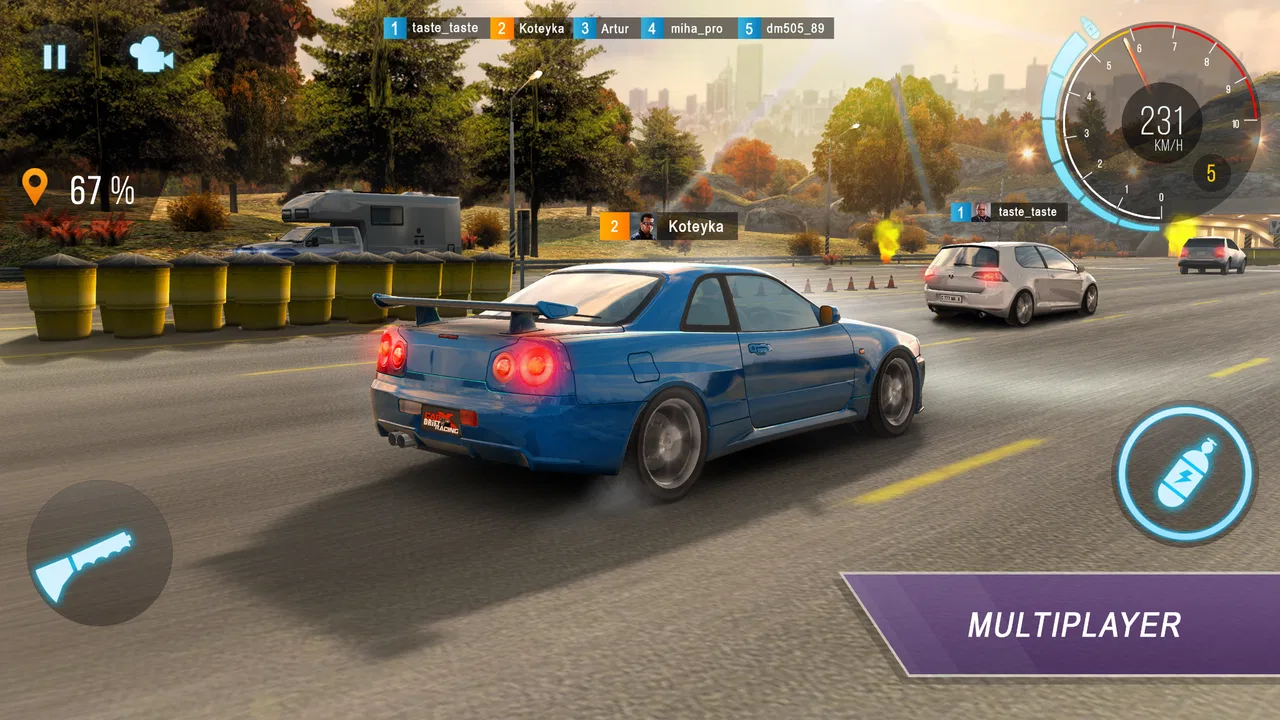
CarX Highway Racing is the kind of mobile racing game I open when I want speed immediately rather than a long setup. It comes from CarX Technologies, sits in the racing category, and is free to start. The central idea is simple: move through busy highways, find openings, and keep the run alive while the road keeps asking for quicker decisions. That focus gives it a more nervous personality than a traditional circuit racer.
My first impression was that the game understands the appeal of a short, dramatic drive. It does not need a complicated explanation to make a highway feel dangerous. Traffic, closing gaps, and the pressure to maintain momentum create a clear rhythm within seconds. The presentation aims for a cinematic road-trip mood, but the controls remain at the center, so the atmosphere is not just decoration.
CarX Highway Racing is rated for Everyone, which makes it approachable for a broad audience, although the concentration required during faster traffic situations may be more demanding than the age label suggests. It has been available since July 26, 2017, and its current version is 1.75.8. The game has grown into a very familiar name on mobile, with over 100 million installs and a 4.7 average from around 1.9 million ratings.
You May Also Like

 Pandora - Music & Podcasts
Pandora’s Music Is Easy to Start, but Harder to Recover
Pandora’s strength is its low-effort path from a seed to a station. Its weak spot is how much confidence it asks you to place in connection, setup, and quiet recovery.

 8 Ball Pool
 Is Built on Rivalries, Rematches, and Routine
A close look at the rivalries, rematches, shared routines, and unanswered safety questions that turn a quick pool match into a persistent mobile community.

 Samsung Music
’s Quiet Strength Is Playing What You Already Own
Its reach comes less from spectacle than from dependable access to a personal library. That simplicity is both the app’s strongest retention engine and its ceiling.

 AccuWeather: Weather Radar
AccuWeather Review: A Quick, Clear Forecast for Everyday Decisions
For everyday plans, the best forecast is the one you can understand quickly. AccuWeather makes rain timing, radar, and local conditions easy to act on, with a few trade-offs.

 Hill Climb Racing
Why Hill Climb Racing Still Turns Crashes Into One More Run
A tiny car, a bumpy hill and one more upgrade: Hill Climb Racing keeps resurfacing because its simple chaos makes every near-miss feel personal.

 AliExpress - Shopping App
AliExpress Makes Global Shopping Feel Personal, but Shoppers Bear the Risk
AliExpress turns a global marketplace into a pocket-sized discovery engine. Its reach is useful, its shopping loop compelling, and its trade-offs easy to miss.
More From Our News Desk
View All News


How the road creates its own visual language
The strongest part of the presentation is the way the highway becomes the game’s main character. A circuit racer gives you corners, braking markers, and a known route. Here, the road feels more like a moving stream of problems. Cars ahead are not simply scenery; they are temporary walls, timing tests, and opportunities to thread through a gap before it disappears.
That setting also helps the game avoid the sterile feeling that can come from repeating a closed track. The highway suggests distance and movement, even when the actual activity is focused on the next few seconds. I like that tension between the apparent openness of the environment and the very narrow choices available at speed. You may see a long road ahead, but your attention is usually locked onto two nearby lanes and the vehicle that has just moved into your path.
The art direction supports this feeling without overwhelming the driving. Roads, vehicles, and surrounding scenery are arranged to keep the important information readable. At a glance, I can usually identify the direction of traffic, the available space, and the danger of committing to a lane change. That clarity matters more here than elaborate visual effects because a beautiful background is worthless if it hides the next obstacle.
There is also a useful contrast between the controlled shape of the road and the unpredictable behavior of traffic. The route gives me a stable visual frame, while the vehicles create variation inside it. This is one of the game’s more effective design choices: the environment does not need to change constantly when the traffic pattern can alter the mood of a run from relaxed to frantic in a moment.
Players who enjoy racing games for customization menus, carefully staged circuits, or highly technical car setups may find the highway focus narrow. That is not necessarily a flaw, but it defines the experience. This is less about studying a perfect lap and more about reacting to a living stream of vehicles. If the pleasure of racing for you comes from clean track geometry, another racing game may be a better fit.
A setting built for short bursts and longer sessions
I find the game especially suitable for those small breaks when I want something more involving than a passive distraction. A quick run can provide a complete burst of tension, while a longer session lets me settle into the road’s rhythm and improve my sense of timing. The important point is that the game does not require me to treat every launch as a major event.
A realistic everyday scenario would be a commute break or a few minutes at home while waiting for dinner. I can start a run, concentrate on traffic, and stop without needing to remember a complicated sequence of objectives. On another day, I may keep playing because one near miss makes me want to try again with a cleaner line. That flexibility is one reason the highway format works well on a phone.
The trade-off is that repetition can become noticeable if I expect a constantly changing world. The same basic challenge remains: read traffic, choose a gap, and avoid losing control of the situation. The atmosphere can make that loop feel fresh for a while, but it cannot completely remove the need for personal tolerance of repetition.
Sound, speed, and the rhythm of a run
Sound plays an important role in making the road feel active rather than empty. Engine noise gives acceleration a physical presence, while the passing traffic reinforces the sense that I am moving through a shared space instead of driving on an abandoned strip of asphalt. Even when I am not paying conscious attention to every sound, the audio helps establish whether a moment feels controlled or urgent.
The game’s rhythm is not built only from speed. It comes from alternating confidence and doubt. A clear stretch lets me settle into a line, then a cluster of vehicles forces a decision. That brief change is more effective than constant maximum intensity because it gives the dangerous moments room to stand out. If every second were equally frantic, the experience would become tiring rather than exciting.
I also appreciate how the sound and visual design work together to communicate momentum. A vehicle sliding past another car feels more convincing when the audio confirms the closeness of the pass. The road then becomes a sequence of small sensory signals: a gap opens, the engine rises, traffic closes, and I have to decide whether to continue or back away from the risk.
That design can be demanding in a different way from a traditional racer. On a circuit, I can often prepare for a corner because the track teaches me its shape. Highway racing asks me to respond to changing information instead. The audio may help maintain focus, but it does not replace concentration. I would not choose this as a relaxing game if I wanted something that could be played almost automatically.
For people who play with sound muted, the game remains understandable because the traffic is visually legible, but the mood loses some of its weight. I get more from it when the audio is available, especially during close passes where the combination of movement and sound makes the risk feel immediate. The presentation is at its best when these elements reinforce the same decision rather than competing for attention.
Why pacing matters more than spectacle
The pacing is carefully tied to the player’s ability to process the road. A run needs enough calm for me to read what is happening, followed by enough pressure to make that reading matter. When the balance works, I am not merely steering toward a destination; I am managing a chain of small judgments. Should I take the opening now, wait for the next one, or accept a slower line to protect the run?
This is where the game differs from a simple endless driving toy. The mood comes from uncertainty, but the mechanics give that uncertainty structure. I can improve by learning not to panic, by looking farther ahead, and by avoiding a tempting gap that closes too quickly. Those are practical skills that carry from one attempt to the next, even when the traffic arrangement changes.
The limitation is that players looking for a deep competitive racing soundtrack or a large variety of racing formats may eventually want more contrast. CarX Highway Racing is most coherent when it stays focused on the highway fantasy. Its strength is also its boundary: it creates a particular kind of driving mood rather than trying to cover every possible form of racing.
Where the mechanics fit the mood
The driving works because the controls serve the central fantasy instead of distracting from it. I am usually thinking about positioning, timing, and the next opening rather than wrestling with a complicated interface. That makes the game easy to understand at first, but the simplicity should not be mistaken for a lack of challenge. The difficulty comes from making good decisions quickly and repeating them consistently.
One useful habit is to look beyond the nearest vehicle whenever the road allows it. If I focus only on the car directly ahead, I can react too late when the next group is already blocking the lane. Reading two or three vehicles forward gives me more time to choose a direction. This is a small but meaningful improvement, and it turns the experience from frantic swerving into planned movement.
Another practical lesson is to value a safe opening over a dramatic one. The most tempting gap is not always the best route. A slightly slower choice can preserve control and leave room for the next change in traffic. I enjoy that trade-off because it gives the game a layer of judgment beyond simply holding the fastest line. Risk can produce a satisfying pass, but unnecessary risk makes the whole run fragile.
I also find that short sessions are useful for learning the game’s pacing. Instead of playing until frustration takes over, I can treat each attempt as a focused exercise: one run for smoother lane changes, another for looking farther ahead, and another for testing how much risk I can handle. This approach makes progress feel more deliberate and prevents the repetition from becoming mindless.
The game is free to play, with in-app purchases ranging from $0.99 to $54.99 per item. That is worth considering before installing, especially if you prefer games that keep all meaningful progression outside optional spending. I would approach the purchase system with a personal budget in mind and avoid treating every obstacle as a reason to pay. The free entry makes it easy to test whether the driving loop suits you before deciding whether anything extra is worthwhile.
Device compatibility is also reasonably broad: the game requires Android 6.0 or later. That does not guarantee identical performance on every phone, but it means the entry barrier is not limited to only the newest hardware. I would still pay attention to heat, battery use, and control comfort during a longer session, because fast traffic games are much less enjoyable when the device becomes uncomfortable or the screen feels cramped.
Who will enjoy it, and who should pass
I would recommend it to someone who likes immediate racing action, close traffic passes, and a strong sense of forward movement. It is particularly appealing if you enjoy games that can be understood quickly but reward better timing after repeated attempts. The road setting gives it a recognizable identity, and the combination of scenery, sound, and traffic creates a mood that is more focused than a generic arcade racer.
I would be more cautious recommending it to someone who wants realistic circuit strategy, extensive tuning, or a calm driving simulator. The highway is the point, so the game keeps returning to that same type of pressure. Players who dislike in-app purchases may also want to decide in advance how they will handle optional spending, since the available purchase range reaches from small amounts to considerably larger individual items.
Compared with a conventional lap-based racer, this game offers less opportunity to memorize a track and perfect a braking sequence. Compared with an endless runner, it gives the movement a more recognizable driving purpose and makes traffic decisions feel central rather than incidental. That middle ground is its most useful comparison: it is more structured than a reflex-only road game, but less methodical than a serious circuit simulator.
It is also a better choice than a track racer when I want a quick sense of danger without committing to a full championship-style session. On the other hand, a circuit-focused alternative is preferable when I want to compare lap times, learn corners, and feel a clear difference between one track layout and another. The right choice depends less on graphics or popularity and more on whether I want traffic management or traditional racing technique.
The atmosphere holds together because the mechanics stay visible
What I value most is the game’s coherence. The setting suggests a long, urgent journey; the sound gives the cars weight; the pacing alternates between breathing room and pressure; and the mechanics turn every nearby vehicle into a decision. None of these parts needs to dominate the others. The atmosphere works because it is constantly supported by what I am doing with my hands.
That connection also makes the limitations easier to understand. The experience can feel repetitive if I need a wide range of event types, and the highway format will not satisfy every racing preference. The optional purchase range may be uncomfortable for players who want a completely frictionless free experience. Still, these concerns do not erase the game’s central accomplishment: it makes ordinary traffic feel like a tense racing environment.
After spending time with it, I see CarX Highway Racing as a focused mobile racer rather than a complete replacement for every other racing game. It is at its best when I want a fast, readable challenge with a strong road-trip mood and enough mechanical depth to reward patience. The Everyone rating and free starting price make it easy to try, while the large player base suggests that the format has broad appeal.
My final recommendation is straightforward: install it if the idea of weaving through busy highways sounds more exciting than following a fixed circuit. Give yourself a few runs before judging it, because the most satisfying improvement comes from learning to plan ahead instead of reacting at the last instant. If you want a richer track-management game or dislike repeating a focused driving loop, choose another racing style. For me, though, the combination of traffic, sound, scenery, and quick decisions creates a convincing playable mood, and that is enough to make this a worthwhile free racing game.
FAQs for CarX Highway Racing
01What devices are compatible with CarX Highway Racing?
CarX Highway Racing is available for both Android and iOS platforms. It requires Android 5.0 or later and iOS 11.0 or later. The game is optimized for smartphones and tablets, ensuring smooth gameplay. Be sure your device meets these requirements for the best experience.
02Is CarX Highway Racing free to play?
Yes, CarX Highway Racing is free to download and play. However, it does offer in-app purchases for players who want to enhance their gaming experience. These purchases include items like new cars, upgrades, and cosmetic enhancements, which can provide advantages in the game.
03Can I play CarX Highway Racing offline?
CarX Highway Racing offers offline gameplay, allowing you to enjoy the game without a constant internet connection. However, to access certain features, such as updates or online leaderboards, you will need to connect to the internet periodically.
04What game modes are available in CarX Highway Racing?
CarX Highway Racing features several game modes, including Campaign Mode, Free Ride, and Online Races. Each mode offers a different experience, from completing missions and objectives in Campaign Mode to competing against other players in real-time Online Races.
05How does CarX Highway Racing ensure fair play and competition?
CarX Highway Racing employs an anti-cheat system to maintain a fair gaming environment. This system monitors gameplay to prevent cheating and unfair advantages. Additionally, regular updates are provided to patch vulnerabilities and improve overall game security.
Pros
- Realistic graphics enhance gameplay.
- Wide variety of cars to choose from.
- Smooth and responsive controls.
- Engaging storyline keeps players hooked.
- Offline mode available for on-the-go play.
Cons
- Some in-app purchases are costly.
- Occasional ad interruptions.
- Limited customization options.
- Requires significant storage space.
- AI opponents can be overly challenging.

CarX Highway Racing
Gallery